
Melanomas and moles
Surgical removal of noticeable or troublesome skin lesions
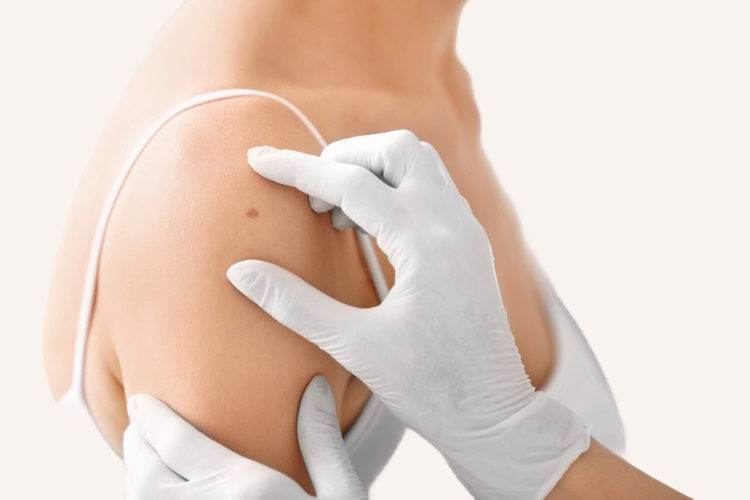
For most people, moles are simply a natural part of their skin. Some have been with us for many years, whilst others appear later in life. However, if a mole changes visibly, is noticed during a skin check-up, or appears as a new and unusual spot, it should be examined by a specialist.
Not every pigmented skin lesion is dangerous – and not every mole needs to be removed. However, if a malignant lesion is suspected, further diagnostic investigations should be carried out in a systematic and structured manner. Even a mole that is clearly benign can be surgically removed if, for example, it is regularly irritated or if you personally find it aesthetically unsightly.
When performing surgical removal, we combine the safety required for medical reasons with incisions that are as gentle on the tissue and inconspicuous as possible, and meticulous plastic-surgical wound care – particularly in visible or anatomically sensitive areas of the body.
Brief overview:
Duration of treatment:
depending on size and location, often around 15–45 minutes
Anaesthesia:
usually a local anaesthetic
Length of stay:
usually on an outpatient basis
Social skills:
depending on the location, usually at short notice
Sport:
depending on the area of the body and the size of the wound
Aftercare:
Wound checks, removal of stitches where necessary, and personalised scar care
What is a birthmark?
Birthmarks – also known medically as Nävi — are defined as localised changes to the skin. Many of them are pigmented and appear brown or dark, but they come in various forms and degrees of severity.
The vast majority of moles are benign and do not require treatment. It is therefore not removal that is the key consideration at this stage, but rather the specialist assessment.
When should a mole be examined?
A birthmark should be assessed more closely, particularly if it:
- appears for the first time or changes significantly
- is increasing in size
- Shape or boundary changed
- developed in different colours
- itchy, weeping or bleeding repeatedly
- is clearly different from the other moles
For patients, the well-known The ABCDE rule to provide some initial guidance:
- Asymmetry
- Bdelimitation
- Ccolour
- Ddiameter
- EDevelopment
- However, it is no substitute for a dermatological examination.
When can a benign mole be removed?
Even a mole that is medically benign can be unsightly. Surgical removal may, for example, be advisable or desired if:
- the birthmark is regularly irritated by clothing, jewellery or shaving
- it is located in a mechanically unfavourable position
- recurring injuries occur
- They find the change aesthetically jarring
Before proceeding with removal for aesthetic reasons, however, it should be ensured that the finding is clinically unremarkable.
How is a birthmark removed surgically?
The skin lesion is completely removed following local anaesthesia via a precisely planned incision. The wound is then carefully closed.
Particularly on the face, neck or other visible areas, we take care to ensure that the incision lines and the direction of the scars follow the natural contours of the skin as closely as possible.
In the case of pigmented or clinically significant lesions, the removed tissue can then be examined histopathologically. This allows the nature of the skin lesion to be assessed under a microscope.
What is a melanoma?
The malignant melanoma is a malignant tumour affecting the pigment-producing cells of the skin. It can develop from an existing mole, but often arises on skin that was previously unremarkable.
An early and definitive diagnosis is crucial for further treatment.
What happens if melanoma is suspected?
In the case of a suspicious mole, the priority is, first and foremost, to ensure it is removed safely from a medical point of view. At the same time, we plan the procedure in such a way that – as far as possible – the subsequent scarring and the aesthetic outcome are also taken into account.
If there is clinical suspicion of malignant melanoma, the S3 Guideline, initially treating the entire noticeable change with a to remove the small safety margin completely. This enables the pathologist to assess the entire set of findings and, in particular, to determine the tumour thickness reliably.
Superficial ablation or purely cosmetic removal is therefore not recommended in cases of suspected melanoma not the appropriate course of action.
Why is histology so important?
The histological examination determines whether,
- whether it is actually melanoma
- how deep the tumour has penetrated into the skin
- what other tumour characteristics are present
- what the next steps in treatment are
The so-called Breslow tumour thickness is one of the key factors in planning further treatment.
What happens if a melanoma is confirmed?
If a malignant melanoma is detected on histological examination, the next course of action depends on the characteristics and thickness of the tumour.
As a rule, this is followed by a second excision, ensuring a safety margin in accordance with clinical guidelines. For certain tumour stages, it may also be necessary to examine the sentinel lymph node or carry out further diagnostic tests. Treatment should then be planned in accordance with oncological guidelines and, where appropriate, carried out on an interdisciplinary basis.
To this end, we work closely with dermatology and pathology departments and – where necessary – other specialist centres to coordinate diagnosis and further treatment as effectively as possible.
Why does plastic surgery play a role in the removal process?
Particularly in the case of larger skin lesions, or where a safety distance in accordance with guidelines is required, a larger skin defect may result following removal.
It is not just a matter of safely removing the lesion from a medical point of view, but also of how the resulting wound can be closed in a way that makes sense both functionally and aesthetically.
As specialists in plastic and aesthetic surgery, we pay particular attention to the following:
- the location and size of the skin defect
- a scar that is as inconspicuous as possible
- low-tension wound care
- the function of adjacent structures
- where necessary, reconstructive procedures such as local flap surgery or skin grafts
Particularly on the face or in functionally sensitive areas, this planning can be crucial to the final result.
After the procedure
Following minor excisions, patients can usually leave the surgery immediately after the procedure. Depending on the size and location of the lesion, temporary swelling, mild pain, a feeling of tightness or bruising may occur. Further aftercare depends on the nature of the lesion that was removed and the extent of the procedure.
In the case of a confirmed melanoma, stage-specific oncological follow-up recommendations also apply. Regular physical and dermatological check-ups form part of melanoma follow-up care.
Particularly on the face or in functionally sensitive areas, this planning can be crucial to the final result.
Frequently asked questions about moles and melanoma
Does every mole need to be removed?
No. Most moles are benign and do not need to be removed surgically. Removal may be medically advisable if a mole appears abnormal or changes in appearance. Benign moles may also be removed if they cause mechanical or aesthetic problems.
Can I have a birthmark removed purely for cosmetic reasons?
Yes. If the change is medically insignificant, personal aesthetic preferences may also be a reason for removal. However, the findings should first be assessed by a specialist.
Will there be a scar after the removal?
Surgical removal always leaves a scar. The aim of plastic surgery planning is to position the scar as favourably as possible and ensure that it heals so that it is as inconspicuous as possible.
Particularly in cases where removal is sought purely for aesthetic reasons, it is therefore always advisable to consider in advance whether the expected scar will actually represent an improvement on the existing birthmark.
Is every mole that is removed examined histologically?
Not every mole that is removed necessarily needs to be examined histologically. However, in the case of conspicuous, unclear or diagnostically relevant findings, a histological examination is important in order to confirm the diagnosis.
At our practice, surgical removal is often carried out following a prior dermatological assessment or on referral from a dermatologist – for example, where surgical excision is requested or where, due to the location and size of the lesion, particularly meticulous plastic-surgical wound management is advisable.
Can a mole reappear after it has been removed?
If a skin lesion is completely removed, there should normally be no residual nevus tissue at the site. However, any recurrence of pigmentation in the scarred area should be monitored by a doctor.
Can a suspicious mole simply be removed with a laser?
If melanoma is suspected, no. Destructive treatment would make a complete histological assessment difficult or impossible. A suspicious pigmented lesion should therefore be removed in accordance with best diagnostic practice and examined histologically.
Is surgical tattoo removal painful?
The procedure is usually carried out under local anaesthetic, so you should not experience any pain during the operation. After the procedure, you may experience a temporary feeling of tightness or mild discomfort at the site of the incision.
Why is surgery initially performed using only a small margin when melanoma is suspected?
The primary purpose of the first operation is to establish a definitive diagnosis. To this end, it must be possible to assess the entire tumour histologically. The guideline recommends, in cases of clinical suspicion of melanoma, an initial complete excision with a small margin around the surrounding healthy tissue; a significantly larger safety margin may be applied only once the histology results are available.
Does an unusual mole automatically mean skin cancer?
No. Many noticeable or unusual skin changes turn out to be benign. Ultimately, only a proper medical or histological examination can reliably confirm whether a melanoma is actually present.
What is a safety distance?
In the case of a confirmed melanoma, in addition to the visible tumour or the tumour that has already been removed, any surrounding tissue that appears healthy is also removed. The size of this safety margin depends on the tumour’s location, in particular its histologically determined thickness.
When can I start exercising again after having a mole removed?
That depends on the size and location of the wound. If the wound is small and located in an area of the body that is not subject to much strain, a short break is often all that is needed. In the case of wounds in areas subject to a great deal of movement, you should avoid putting any strain on the fresh scar for a longer period.
Will the health insurance cover the costs?
The costs are covered by health insurance. The removal of a benign mole for purely cosmetic reasons is usually a service that patients must pay for themselves.
What should you look out for when choosing a doctor / clinic?
When choosing a specialist, make sure that you use the term Specialist in Plastic and Aesthetic Surgery. Other designations such as beauty doctor, cosmetic surgeon, etc. are unprotected and not a sign of qualification (more on "What should you consider when choosing a specialist?„.
Make sure that you receive a comprehensive preliminary examination and information about the course of treatment, possible risks and the healing process.
Why should you come to us?
Extensive experience, maximum hygiene and infection protection, continuous further training and maximum care are the basis of our practice. This is also reflected in the large number of positive patient reviews, our seals and awards.
Benefit from our many years of experience. Dr Michaela Montanari has been a member of the board of the German Society for Aesthetic Plastic Surgery (DGÄPC) since 2021.
What do patients say about us?
The reviews shown here come directly from our Google, Jameda and Trustindex profile. This is monitored and checked by the respective provider themselves. This means you can see real testimonials from our patients - transparent, up-to-date and reliable.
Do you have any questions?
Dr Michaela Montanari and Dr Anna Maria Bugariu will be happy to answer any questions you may have. Arrange your personal consultation.
Our specialists for plastic and aesthetic surgery

Specialist in plastic and aesthetic surgery
Specialist for surgery
Chairperson of the
German Society for Aesthetic Plastic Surgery

Specialist for
Plastic and aesthetic surgery