
Breast implants: Which implant is right for me?
There is no such thing as the „best“ breast implant.
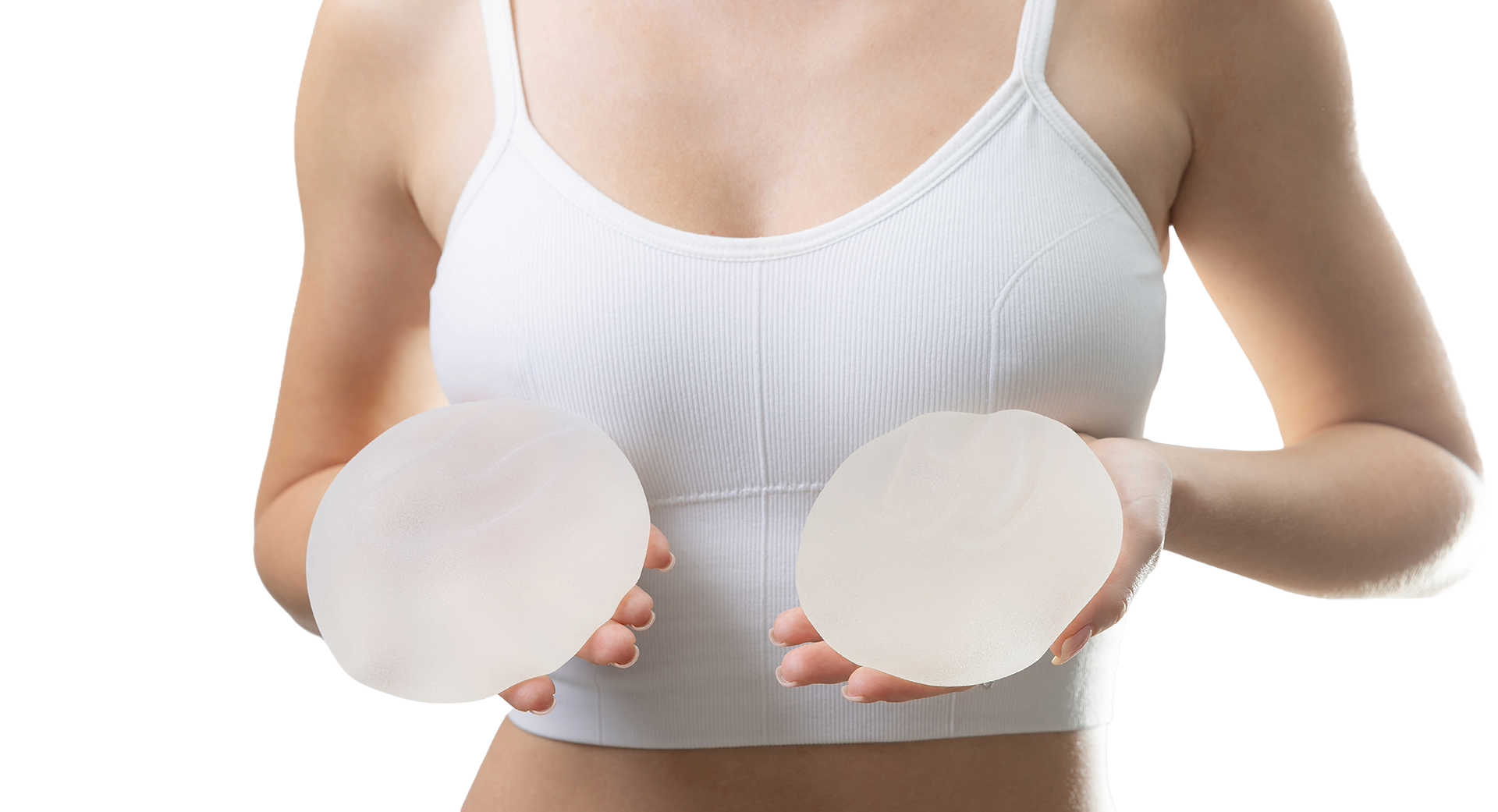
The key factor is which implant is best suited to your anatomy, your tissue, your personal expectations and the chosen surgical technique. Modern breast implants differ not only in size, but also in shape, projection, surface texture, material properties and weight. In our practice, we therefore work with a range of implant systems and select them on a case-by-case basis.
Anyone who is dealing with a Breast augmentation Anyone looking into this subject will soon come across a whole host of terms: round or anatomical, smooth or textured, different profiles, various manufacturers, classic silicone implants or ultra-light implants. Added to this are questions about safety, durability, aftercare and potential risks.
A good decision therefore does not start with the question of a particular brand or a specific number of millilitres. It starts with a detailed consultation and a careful analysis of individual circumstances.
What are the differences between breast implants?
Modern breast implants are available in a wide range of types. These differences make it possible to tailor the choice very specifically to each individual patient.
The most important criteria include:
- Size and volume
- Base width
- Shape
- Projection or profile
- Surface texture
- Properties and strength of silicone gel
- Weight of the implant
All these factors determine how well an implant fits the existing anatomical conditions.
Round or anatomical breast implants?
Round implants have a more uniform shape and – depending on the type of implant, projection and tissue – can, amongst other things, create more fullness in the upper breast area. So just because an implant is round does not necessarily mean it will look unnatural.
Anatomical implants are often described as teardrop-shaped because of their shape. The distribution of volume more closely resembles the natural shape of the breast.
However, the most suitable shape does not depend solely on the desired appearance. The basic structure of the breast, existing tissue, the rib cage, skin condition and the surgical plan also play a role.
„There is therefore no one-size-fits-all answer to the question “Round or anatomical?”.
What does the projection of a breast implant mean?
How do I find the right implant size?
One of the most common questions asked during a consultation is: How many millilitres do I need to achieve my desired cup size?
There is no reliable, universal answer to this question. 300 or 350 ml can produce completely different results in two different women. Height, chest circumference, existing breast tissue, the initial shape of the breasts, implant width and projection all influence the final result.
Bra cup sizes are not a standardised medical unit of measurement either.
When selecting implants, we therefore do not simply consider a single figure or our patients’ previous cup size in isolation, but focus in particular on:
- the width and shape of the ribcage
- the existing breast tissue
- the natural shape of the breast
- possible asymmetries
- the texture of the skin and tissue
- the required volume
- the desired projection
- the planned implant position
- the patient’s personal views
Our aim is not to choose the largest or smallest size possible, but to find an implant whose dimensions are suited to the individual’s anatomy and the desired outcome.
What are the benefits of breast implants?
Breast augmentation using implants allows for relatively precise planning of volume and shape. Depending on the initial situation and the implant chosen, it is possible, for example, to restore lost breast volume, alter proportions or correct asymmetries.
Unlike the Breast augmentation with autologous fat More significant changes in volume are also possible without the need for sufficient body fat.
Why is the quality of a breast implant so important?
Breast implants generally remain in the body for many years. It is therefore particularly important to us that the medical device is of high quality, that there is proper documentation and traceability, and that the manufacturer provides reliable information. For us, responsible implant surgery therefore involves not only the selection of a high-quality implant, but also careful surgical planning, expert execution and long-term aftercare. Even the highest-quality implant cannot replace good surgical planning and technique.
What types of breast implants do we use?
We have deliberately chosen not to limit ourselves to a single implant model. Different anatomical conditions and patient preferences may require different solutions.
We therefore use a range of high-quality implant systems in our practice, depending on the individual case.
POLYTECH® breast implants
POLYTECH offers a comprehensive range of implant shapes, base designs, projections and surface finishes. This variety allows for a personalised selection tailored to the patient’s anatomy and the desired treatment outcome.
B-Lite® Lightweight Implants – does weight matter?
In addition to conventional silicone implants, there are B-Lite® particularly lightweight breast implants are available. B-Lite® implants can, for the same volume, up to 30 per cent lighter than conventional silicone implants. This is made possible by special microspheres that are incorporated into a cohesive silicone gel.
The reduced weight is intended to minimise the long-term strain on breast tissue caused by the weight.
Particularly in cases involving specific anatomical conditions or a desire for a larger implant volume, weight can therefore be an additional factor to consider when selecting an implant. However, whether a lightweight implant offers advantages in an individual case must be assessed just as carefully as the choice of shape, size and projection.
Motiva® implants and Preserve™
Motiva® provides us with yet another state-of-the-art implant system.
In our practice, Motiva® implants are used in conjunction with the Preservé™ surgical concept is used. Preserve™ is not an implant in its own right, but rather a surgical approach designed to minimise tissue damage, which has been developed specifically for use with Motiva® implants.
The aim is to preserve anatomical structures as much as possible during the operation and to minimise damage to the surrounding tissue.
POLYTECH®, B-Lite® or Motiva® – which implant is better?
There is no one-size-fits-all answer to this question either. A particular manufacturer or type of implant is not automatically the best choice for every patient. Rather, the decisive factor is which characteristics are appropriate for the patient’s specific anatomy, the desired outcome and the planned operation.
We therefore do not view the fact that various implant systems are available to us as a question of product choice, but rather as part of an individual treatment plan.
Frequently asked questions and answers about breast implants
What problems can arise with breast implants?
Every operation carries general and procedure-specific risks. Even modern breast implants can be associated with complications.
Possible problems include, amongst others:
- Capsular fibrosis
- Rupture or damage to the implant
- Change in position or rotation
- Asymmetries
- implant margins that are visible or palpable
- Creasing or rippling
- Infections
- Fluid build-up
- Changes in the aesthetic outcome over time
- the need for an implant replacement or further surgery
We explain in detail the risks that apply to you as an individual during a face-to-face consultation.
What is capsular fibrosis?
The body forms a natural connective tissue capsule around each breast implant. This is, initially, a normal reaction.
Capsular fibrosis causes this capsule to thicken or harden to a greater extent. Depending on the severity, the breast may become firmer, change shape or cause discomfort.
Capsular fibrosis is usually categorised into different degrees of severity according to the so-called Baker classification.
Not every case of capsule formation requires treatment. However, in cases where the findings are significant, a further operation may be necessary.
Can a breast implant rupture?
Yes. Even modern breast implants can be damaged, or their casing may lose its integrity over time.
With silicone gel implants, a rupture does not necessarily cause symptoms straight away. That is why regular medical check-ups are advisable even if the breast feels completely normal.
If a change is suspected, imaging tests such as ultrasound or MRI may be used for further investigation.
What is BIA-ALCL?
BIA-ALCL means Breast Implant-Associated Anaplastic Large Cell Lymphoma. This is a rare form of lymphoma that has been reported in connection with breast implants.
The condition does not originate in the breast tissue itself, but typically in the area of the capsule surrounding the implant. The risk has been observed in particular in connection with certain textured implant surfaces.
Any new, unilateral swelling of the breast, a build-up of fluid around the implant or other noticeable changes should therefore be investigated by a doctor.
For us, even rare risks form part of providing comprehensive and transparent information.
What is Breast Implant Illness (BII)?
Breast Implant Illness, in short BII, is a term used to describe a range of different physical and, in some cases, psychological symptoms reported by some women with breast implants.
The symptoms mentioned include, amongst others:
- persistent tiredness and exhaustion
- Problems with concentration and memory („brain fog“)
- Joint and muscle pain
- Headache
- Skin changes or rashes
- Hair loss
- Sleep disorders
- Changes in weight
- general feeling of being unwell
It is important to take a nuanced view of this: BII is not currently a separate, formally recognised medical diagnosis. To date, there are neither clear diagnostic criteria nor a specific test that can be used to diagnose Breast Implant Illness.
However, this does not in any way mean that the symptoms described by patients should not be taken seriously. If one or more of these symptoms occur, they should be carefully assessed and investigated by a doctor.
Furthermore, the causes of the symptoms described and any possible causal link with breast implants have not yet been conclusively established by scientific research. Many of the symptoms mentioned may also have numerous other medical causes.
Can symptoms improve following the removal of an implant?
Some female patients report that their symptoms have improved, either partially or completely, following the removal of their breast implants. This is also described in scientific studies and by international health authorities. However, it is not possible to predict whether symptoms will improve. Nor does an improvement following explantation in an individual case automatically prove that the implant was the original cause of the symptoms.
If such symptoms are present, it is therefore important to undergo a thorough medical examination first, during which other possible causes are also taken into account.
For us, BII is now an integral part of providing comprehensive and transparent advice on breast implants. Even though many questions have not yet been conclusively answered from a scientific perspective, we take our patients’ complaints and concerns seriously and discuss together which diagnostic and, where appropriate, therapeutic steps are appropriate in each individual case.
What have we learnt from the past?
The history of breast implants also has its problematic chapters.
The PIP scandal around Implants, in which unauthorised industrial-grade silicone was used, and the discussions and recalls of certain types of implants in connection with BIA-ALCL and BII have brought about a lasting change in attitudes towards the long-term safety of breast implants.
For us, the implication is not that we should ignore past implant scandals. On the contrary: they have shown just how important Product quality, traceability, transparent manufacturer information, long-term monitoring and reliable aftercare are.
Patients should know which implant they have and keep the relevant documentation for the long term.
What is an implant passport – and are breast implants registered centrally?
Following implantation, patients receive a Implant passport containing important information about the breast implants used. This includes, amongst other things, the manufacturer, the name and type of the implant, as well as specific product details.
This documentation should be kept carefully and for the long term. It enables the implant to be clearly identified even years later – for example, during follow-up examinations, if you change doctors, or if new safety information regarding a specific type of implant becomes available.
What is the Implant Register in Germany (IRD)?
In addition to the personal implant passport, there is now another important pillar of patient safety in Germany: the German Implant Register (IRD).
Since 1 July 2024, healthcare facilities have been required to report implant-related procedures involving breast implants to the central register. This requirement is based on the Implant Register Act (IRegG).
The register systematically records information on implants and the associated medical procedures. The aim is to improve the long-term assessment of the quality and safety of implants and to identify any potential anomalies or safety risks at an early stage. Centralised recording also improves the traceability of implants and creates a broader data base from which to gain insights into implants and implant-related medical procedures.
The implant passport and the implant register complement one another: whilst the implant passport provides the patient with personal information about their implant, the central register serves the wider purposes of quality assurance and patient safety.
What does „warranty“ mean in relation to breast implants?
Various manufacturers offer warranty or replacement schemes for their implants. The scope and conditions of these schemes vary.
It is important to bear in mind one key distinction:
A manufacturer’s warranty does not mean that a breast implant is guaranteed to last a lifetime. Nor does it automatically mean that all the costs of any subsequent surgery will be covered.
Depending on the manufacturer and the warranty scheme, replacement implants may, for example, be provided in the event of a proven rupture or certain forms of capsular fibrosis. In some cases, there are additional schemes which contribute towards further costs under defined conditions.
Some programmes also require the implant to be registered within certain time limits.
We explain to our patients which warranty terms apply to the specific implant they have chosen during their consultation.
Do breast implants need to be replaced after ten years?
Following breast augmentation surgery, the agreed post-operative follow-up appointments form an initial part of the treatment plan.
We also recommend having breast implants checked regularly by a doctor in the long term. During these check-ups, the shape, position and condition of the breast, as well as any possible changes, are assessed.
Depending on the implant, its age, the patient’s individual circumstances and the clinical findings, additional imaging tests such as ultrasound or MRI may be advisable.
It is also important to note that: Implant checks are not a substitute for regular breast cancer screening.
We discuss with our patients individually which screening intervals and examination methods are recommended in each specific case.
Which changes should I have checked by a doctor?
Regardless of regular check-ups, any new or unusual changes should be investigated.
These include, for example:
- sudden swelling on one side
- increasing polarisation
- newly occurring pain
- Changes in the shape or position of the breast
- tangible changes
- Fluid build-up
- striking asymmetries
Such symptoms do not automatically mean that there is a serious complication. However, they should be assessed by a doctor.
Can I have a mammogram if I have breast implants?
Yes. Breast cancer screening is still possible even if you have breast implants.
It is important to inform the clinic carrying out the examination that you have breast implants before having a mammogram. This allows the examination technique to be adjusted accordingly. Ultrasound and MRI scans can also be carried out on patients with breast implants.
Can I breastfeed with breast implants?
In many cases, it is still possible to breastfeed following breast augmentation surgery. However, whether the ability to breastfeed is retained, and to what extent, depends on various individual and surgical factors. If you have specific plans to have children, this issue should therefore be discussed during the consultation.
What happens to breast implants during pregnancy or when your weight changes?
Breast implants themselves do not automatically change as a result of pregnancy. However, the natural breast tissue and skin may change due to pregnancy, breastfeeding, the ageing process or significant fluctuations in weight. This can also alter the appearance of a breast that has previously undergone surgery.
If necessary, a correction or tightening may be requested at a later date, or may become medically advisable.
Removing or replacing breast implants – when might this be necessary?
An implant replacement may be necessary or desired for various reasons – for example, in the case of a Rupture, pronounced Capsular fibrosis, Changes in position or the desire for a of a different size or shape.
Similarly, some women make a conscious decision, after many years, to have their implants removed completely.
The options available and whether, for example, a breast lift might also be advisable depend on the individual findings.
Which breast implant is the right one?
Ultimately, the sheer number of options brings us back to the most important question: What’s right for me?
The key factors are your anatomy, your tissue, your personal expectations and a realistic assessment of what is medically and aesthetically feasible.
Dr Michaela Montanari has many years’ experience in plastic and aesthetic surgery and is a breast surgeon certified by the DGPRÄC. Our practice offers a range of implant systems and surgical techniques.
We therefore do not aim to recommend a specific breast implant to you before we have seen you. Our aim is to work with you to find the solution that best suits you in the long term.
Do you have any questions?
During a face-to-face consultation, we take the time to assess your current situation and discuss your wishes. Together, we will determine which implant shape, size, projection and surgical technique are suitable for you, and whether breast augmentation with implants is the right treatment for you at all.
After all, making the right decision about breast implants doesn’t start with a brand or a number – it starts with a good consultation.
Our specialists for plastic and aesthetic surgery

Specialist in plastic and aesthetic surgery
Specialist for surgery
Chairperson of the
German Society for Aesthetic Plastic Surgery

Specialist for
Plastic and aesthetic surgery