Breast augmentation with implants
from woman to woman

Breast augmentation using implants makes it possible to specifically alter the volume, shape and proportions of the breast. However, it is not just the size of the implant that is crucial for a natural-looking result. The patient’s anatomy, existing breast tissue, the shape and position of the implant, and the surgical technique chosen must all be tailored to the individual.
Breast augmentation with implants – also known medically as Breast augmentation — is one of the well-established procedures in plastic and cosmetic surgery. The reasons why women are interested in this procedure vary greatly.
Some women feel that their breasts are naturally too small, whilst others wish to regain volume lost following pregnancy, breastfeeding or weight loss. Breasts of different sizes or shapes may also be a reason to seek a consultation.
For us, it is not about conforming to a particular ideal of beauty. The starting point for every treatment is the patient’s individual wishes and anatomical characteristics.
Brief overview
Duration of treatment:
approx. 45–120 minutes
Anaesthesia:
General anaesthesia
Length of stay:
outpatient or inpatient – depending on the extent of the operation and the individual’s circumstances
Follow-up treatment:
special compression bra, and a chest strap if required
Taking care of your body:
approx. 1–2 weeks
Sport and increased physical exertion:
Avoid this for about 6 weeks as a rule
Result:
develops as the healing process progresses and becomes increasingly apparent once the swelling has subsided
Who is a good candidate for breast augmentation with implants?
Breast augmentation using implants may be a suitable option, particularly if a significant or easily predictable increase in volume is desired.
Possible reasons include, for example:
- a naturally small bust
- Loss of volume following pregnancy or breastfeeding
- Changes following significant weight loss
- breasts of different sizes or shapes
- the desire for a change in breast shape or projection
- the desire for a fuller bust
This requires a thorough medical examination and consultation.
Not every wish can be meaningfully fulfilled by an implant alone. If, for example, there is a lot of excess skin or the breast has sagged significantly, an additional Breast lift may be necessary.
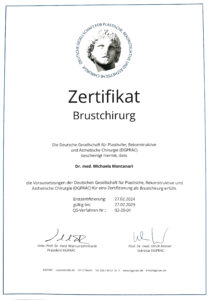
Dr Montanari has been appointed to the Supervisory Board on 27.02.24 by the DGPRÄC certified breast surgeon
Implants or autologous fat – which breast augmentation is right for me?
In general, there are various procedures available for breast augmentation.
With a Implant It is possible to plan volume and shape with a relatively high degree of precision and to achieve more pronounced changes in volume.
One Breast augmentation with autologous fat On the other hand, it may be of interest to women who have made a conscious decision not to have implants and are looking for a more moderate increase in volume. One of the prerequisites is that there is a sufficient amount of suitable fat tissue available.
In certain situations, the two procedures can also be combined. Autologous fat, for example, can be used to further refine transitions or to optimise specific areas where soft tissue coverage is poor.

How is breast augmentation with implants planned?
Careful planning is an essential part of the operation. During your personal consultation, we will first discuss what changes you would like to make to your breasts and what results you envisage.
We then assess, amongst other things:
- The size and shape of the existing breast
- Width and shape of the chest
- existing breast tissue
- Skin and tissue structure
- Position of the nipples
- possible asymmetries
- desired volume and desired projection
On this basis, the implant, its size, its position and the surgical technique are selected.
Planning therefore does not begin with the question „How many millilitres would you like?“, but with the question: What result suits your body?
Which implant size is the right one?
The size of the implants is one of the most common questions asked before breast augmentation – and, at the same time, one of the questions that is least likely to be answered by a single figure.
An implant with, for example, a volume of 300 ml can produce completely different results in two different patients. Body height, chest width, existing breast tissue, implant shape and projection all influence the outcome. Nor can a desired bra cup size be reliably translated into a specific implant volume.
For this reason, the size of the implant is always selected in accordance with the individual’s anatomy.
What types of breast implants are used?
Modern breast implants vary in terms of size, shape, projection, surface texture, material properties and, in some cases, their weight.
At our practice, we use a range of high-quality implant systems, including POLYTECH®, B-Lite® lightweight implants and Motiva®. We do not base our recommendation of which implant to use on a particular manufacturer, but rather on the individual circumstances and the desired outcome.
You can find detailed information on implant shapes, sizes, B-Lite®, Motiva®, POLYTECH®, implant quality, durability, guarantees and potential long-term risks on our information page:
Above or below the pectoral muscle – where is the implant inserted?
During breast augmentation, the implant can be positioned in different layers of tissue, depending on the patient’s anatomy and the surgical plan. One possible position is beneath the breast tissue and above the pectoral muscle. Provided there is sufficient soft tissue coverage, this may be a suitable option.
Alternatively, the implant can wholly or partly beneath the pectoral muscle be positioned. This may be particularly useful in patients with little natural breast tissue, in order to provide additional tissue coverage over the implant.
There is no one-size-fits-all answer as to which position is the most suitable. Key factors include the amount of overlying tissue, breast shape, implant size and individual anatomy.
Where is the scar after a breast augmentation?
An incision in the skin is required to insert a breast implant. Access is often gained via the natural underbust fold. As a result, the resulting scar lies within an anatomical fold and is usually relatively inconspicuous once it has fully healed.
Depending on the initial situation and the surgical technique, other approaches may also be considered. The most appropriate incision is determined on a case-by-case basis during the pre-operative planning stage.
How does the operation work?
Breast augmentation is carried out under general anaesthetic (with the exception of: Preservé™ technology, (local anaesthesia is used here, combined with twilight sleep) and usually lasts around one to two hours, depending on the patient’s initial condition and the surgical technique. Before the operation, the planned implant position and key anatomical landmarks are marked on the skin.
Using the access route determined beforehand, the implant site is then prepared as precisely as possible. The selected implant is then inserted and its position checked.
Particular emphasis is placed on symmetry, implant position and ensuring the transition to the existing breast tissue is as harmonious as possible.
Once the operation is complete, the incisions are carefully closed and the breast is stabilised using a special bra.
What is Preservé™?
In addition to established surgical techniques, we also offer the following to suitable patients: Preservé™ surgical concept to.
Preservé™ is not a breast implant in its own right, but rather a surgical approach designed to minimise damage to tissue, which is used specifically in conjunction with Motiva® implants.
The aim is to preserve anatomical structures as far as possible whilst preparing the implant site and to minimise disruption to the surrounding tissue. Whether Preserve™ is suitable for a particular patient depends on her individual anatomical conditions and the planned choice of implant.
Another distinctive feature of Preservé™ is that, in most cases, the procedure can be carried out on an outpatient basis under local anaesthesia combined with twilight sedation. General anaesthesia is not required, but may, of course, be chosen if desired.
When is a breast lift also required?
An implant increases breast volume – but it cannot remove excess skin. Following pregnancy, breastfeeding, significant weight fluctuations or with advancing age, the breast tissue may have sagged. If this is particularly pronounced, a breast augmentation alone may not be sufficient to achieve the desired result.
In such cases, a combination of Breast augmentation and breast lift make sense.
Whether an implant alone is sufficient or whether an additional lift is required can only be reliably assessed following an examination.
Outpatient or inpatient?
Whether a breast augmentation can be carried out on an outpatient basis or whether an inpatient stay is advisable depends on the individual situation, the extent of the operation, the type of operation and medical factors.
Following an outpatient operation (e.g. using Preservé™), patients initially remain under medical supervision. Only once all medical criteria have been met may they return home accompanied by someone.
Our priority is not to discharge patients as quickly as possible, but to ensure that each patient receives safe treatment.
Frequently asked questions and answers
How painful is breast augmentation?
The level of pain experienced following breast augmentation varies from person to person and may also depend on the surgical technique chosen and the position of the implant.
During the first few days, you may experience, in particular, a feeling of tightness, pressure, swelling and pain. These symptoms will gradually subside as the wound heals, and can be managed with appropriate pain relief.
It is not possible to make a reliable statement such as „pain-free“ or to predict an individual’s experience of pain with any certainty prior to an operation.
What can I expect after the operation?
In the first few days following breast augmentation, rest and recovery are the priority. Swelling, a feeling of tightness and bruising may occur initially. A specially fitted compression bra supports the healing process and stabilises the operated breast. Regular follow-up appointments form part of our treatment plan. During these appointments, we assess how the healing is progressing and discuss, step by step, when certain everyday and leisure activities can be resumed.
When will I be able to return to social life and work?
Many female patients are able to resume light everyday activities after just a few days. When it is possible to return to work depends largely on the nature of the job and the individual’s recovery. For those in predominantly sedentary roles, this is often possible sooner than for those in physically demanding occupations.
To begin with, you should avoid heavy lifting, putting excessive strain on your upper body and making sudden movements.
When can I start exercising again after a breast augmentation?
Light exercise is usually possible and recommended relatively early on in the recovery process. Vigorous exercise, heavy lifting and strenuous activity involving the upper body should generally be avoided for around six weeks. The timing for resuming specific sports will be discussed on an individual basis during follow-up appointments.
When will the final result be visible?
Immediately after the operation, the breast does not yet look as it will eventually. Swelling and the initial change in tissue tension affect its shape and position. Over the course of the following weeks, the swelling subsides and the tissue gradually adapts. The final result therefore develops gradually. How long this process takes varies from person to person.
What are the risks associated with breast augmentation using implants?
Like any operation, breast augmentation carries both general and procedure-specific risks.
Possible general complications include, amongst others, post-operative bleeding, infections, impaired wound healing, scarring problems, swelling and bruising.
Depending on the specific implant, complications such as capsular fibrosis, displacement, asymmetry, visible or palpable implant edges, rippling or rupture may occur. In certain situations, this may subsequently require further surgery or a Implant change become necessary.
In addition, there are aspects that are rare or are still being investigated by scientists, such as BIA-ALCL and those covered by the term Breast Implant Illness (BII) the systemic symptoms described.
For us, providing detailed and transparent information about potential risks is just as much a part of breast augmentation as the planning and performance of the operation.
→ Detailed information on risks, capsular fibrosis, BIA-ALCL, BII and implant safety
Can breast implants remain in the body for a lifetime?
There is no general expiry date for breast implants after which they must automatically be replaced.
At the same time, it should not be assumed that an implant can, as a matter of principle, remain in the body unchanged for life. Regular check-ups are therefore important in the long term. Replacing an implant may, for example, be necessary or desired in the event of a rupture, capsular fibrosis or a change in position, or for personal reasons.
→ Find out more about Implant change
Pregnancy after breast augmentation – is it possible?
In principle, it is possible to become pregnant even with breast implants. However, pregnancy and breastfeeding can alter the natural breast tissue and skin. This can also change the appearance of a breast that has previously undergone surgery.
If you are planning to have children in the near future, it may therefore be advisable to give particular consideration to the timing of a planned breast augmentation during your consultation.
Can I breastfeed with breast implants?
In many cases, the ability to breastfeed is preserved following breast augmentation. However, it cannot be guaranteed with certainty for a future pregnancy, whether or not breast surgery has been carried out previously. Any desire to have children and the importance of breastfeeding should therefore be discussed openly before the operation.
How long do the results of breast augmentation last?
Breast augmentation results in a long-term change in volume and shape. However, the breast itself continues to undergo natural changes.
Ageing, gravity, pregnancies, breastfeeding and significant fluctuations in weight can alter the skin and breast tissue, even after surgery.
A long-term, satisfactory result therefore depends not only on the implant, but also on the individual’s tissue characteristics and the physical changes that occur over the course of a lifetime.
How much does a breast augmentation with implants cost?
The cost of breast augmentation depends on the specific scope of treatment, the surgical technique and the implants used.
A binding cost estimate can therefore only be provided following a face-to-face consultation and once specific surgical plans have been drawn up. You will then receive a transparent, personalised cost breakdown.
Experience and modern breast surgery
For us, breast augmentation is not a standardised operation carried out according to a set procedure.
Dr Michaela Montanari has many years’ experience in plastic and aesthetic surgery and is a breast surgeon certified by the DGPRÄC.
Our practice offers a range of implant systems and surgical techniques, as well as breast augmentation using the patient’s own fat. This enables us to work with our patients to determine which approach best suits their anatomy, their wishes and their personal circumstances.
Our aim is not to use a specific implant size or surgical technique. Our aim is to create breasts whose shape and proportions suit each individual patient – and to ensure she is happy with her decision in the long term.
Are you interested in breast augmentation with implants?
A website can answer many questions. However, it is only possible to determine which implant size, shape and surgical technique are suitable for you following a face-to-face consultation.
During a detailed consultation, we take the time to listen to your wishes and answer your questions, assess your anatomical conditions and discuss the various options with you, along with their limitations and risks.
After all, a successful breast augmentation does not begin with the choice of an implant – but with a thorough consultation.
What should you look out for when choosing a doctor?
When choosing a specialist, make sure they are qualified as a specialist in plastic and aesthetic surgery. Other titles, such as „beauty doctor’ or ‘cosmetic surgeon’, etc., are not protected and do not indicate any particular qualification (more on the topic ‘What should you consider when choosing a specialist?".
Make sure that you receive a comprehensive preliminary examination and information about the course of treatment, possible risks and the healing process.
Why should you come to us?
Extensive experience, maximum hygiene and infection protection, continuous further training and the utmost care are the basis of our practice. This is also reflected in the large number of positive patient reviews and our seals & awards.
Make the most of our nearly 20 years’ experience to achieve the changes you desire. Dr Michaela Montanari has been a member of the Executive Board of the German Society for Aesthetic and Plastic Surgery (DGÄPC) since 2021 and has served as its President since 2025. In addition, she has been certified by the DGPRÄC certified breast surgeon.
Do you have any questions?
We’d be happy to answer any questions you may have about the procedure, options, risks or recovery following breast augmentation with implants. Book your personal consultation. We’ll advise you individually on your options.
Our specialists for plastic and aesthetic surgery

Specialist in plastic and aesthetic surgery
Specialist for surgery
Chairperson of the
German Society for Aesthetic Plastic Surgery

Specialist for
Plastic and aesthetic surgery