
Surgical tattoo removal
When is surgery a sensible option?
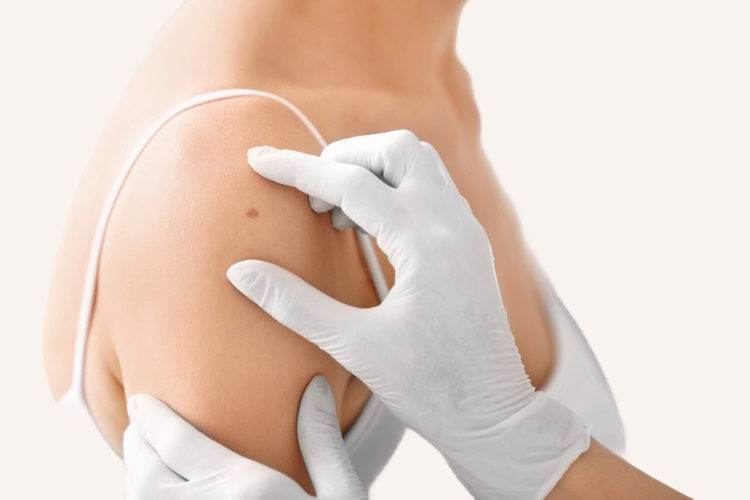
What felt just right in the past may no longer feel right years later. If a tattoo no longer fits with your outlook on life, having it removed can be a conscious decision.
Nowadays, anyone wishing to have a tattoo completely removed usually thinks of laser treatment first. However, laser treatment is not automatically the right solution for every tattoo or every patient. For smaller tattoos in convenient locations, surgical removal may be an alternative.
This procedure does not involve attempting to break down the colour pigments gradually. The tattooed area of skin is completely excised and the resulting wound is then closed using plastic surgery techniques.
The key difference is therefore clear: the tattoo is removed after the operation – and a scar takes its place.
This is precisely where careful planning is essential. The aim is to position and shape the resulting scar so that it blends in as inconspicuously as possible with the natural lines of the skin.
At a glance:
Duration of treatment:
Depending on the size and location, usually around 30–60 minutes
Anaesthesia:
usually a local anaesthetic
Length of stay:
usually on an outpatient basis
Social skills:
depending on the location and scope, usually at short notice
Sport:
depending on the area of the body and the size of the wound
Aftercare:
Wound checks, removal of stitches where necessary, and personalised scar care
For which tattoos is surgical removal an option?
It is equally important whether the skin can close up again after removal without excessive tension.
Particularly suitable examples might include:
- smaller tattoos
- narrow or elongated designs
- Tattoos on parts of the body where the skin has sufficient mobility
- Remaining tattoo pigment following other treatments
- Tattoos where scarring is deliberately accepted
With larger tattoos, however, complete removal in a single operation can result in a skin defect that is too large. In certain cases, a gradual surgical removal over several sessions be possible.
How does surgical tattoo removal work?
Before the procedure, we assess the size, location and pattern of the tattoo, as well as the condition and mobility of the surrounding skin. Under local anaesthetic, the tattooed area of skin is surgically removed. The edges of the wound are then mobilised to allow for closure with as little tension as possible.
When planning, we take the following factors into particular consideration:
- the design of the tattoo
- the skin’s natural lines and creases
- the location of the future scar
- the mobility of the surrounding skin
- the functional requirements of the relevant part of the body
The wound is then carefully closed in several layers.
What is the difference compared to laser tattoo removal?
During laser treatment, the tattoo ink is broken down into smaller pigment particles by short pulses of light. These are then gradually broken down by the body.
The reasons for this are several treatment sessions at appropriate intervals necessary. How easily a tattoo can be removed depends, amongst other things, on the colour, pigment, depth, size and skin type. Some colours are more difficult to treat than others, and complete removal is not always possible.
Even laser treatment does not always leave the skin entirely unchanged. Changes in pigmentation may occur, in particular lighter patches of skin – known as hypopigmentation – as well as, in rare cases, scarring or changes to the skin’s structure. If pigmentation remains reduced in a treated area, it may appear significantly lighter, particularly against the background of tanned surrounding skin.
With surgical removal, on the other hand, the tattooed skin itself is removed. This eliminates the need for the lengthy, gradual breakdown of pigment.
Potential benefits of surgical removal
- Surgical removal of the tattooed area of skin
- no lengthy course of laser treatments
- The result does not depend on the colour of the tattoo pigments
- no residual colour pigments in the area of skin where the pigment has been removed
- precise planning of the future scar line
What are the disadvantages of surgical tattoo removal?
The main difference compared with laser treatment is also a drawback: the operation leaves a scar.
How visible this is later on depends, amongst other things, on:
- Size of the tattoo removed
- Body part
- Skin texture
- Tension on the wound
- individual scar formation
- Behaviour during the recovery period
That is why, before any operation, you must always weigh up the options together: Is the resulting scar a better alternative for you than a tattoo?
Can larger tattoos also be removed surgically?
The larger the tattoo, the more difficult it is to close the wound directly.
In the case of larger designs, it may be possible in certain instances to remove only part of the tattoo initially and to carry out the remainder of the removal after complete healing, in a second or subsequent operation. This procedure is known as serial excision (gradual removal).
Whether this is sensible and aesthetically acceptable depends very much on the location, the amount of excess skin and the shape of the tattoo.
Why does plastic surgery play a special role?
With surgical tattoo removal, one thing is clear even before the first incision is made: the tattoo will disappear, but a scar will remain.
This makes the question of how this scar will develop later all the more important.
As specialists in plastic and aesthetic surgery, we therefore take the following into account right from the planning stage:
- a scar that is as inconspicuous as possible
- natural skin lines and creases
- wound closure with as little tension as possible
- the mobility of adjacent structures
- an aesthetic result that is as unobtrusive as possible
This forward planning is particularly important when it comes to visible parts of the body.
After the procedure
Following minor tattoo excisions, patients can usually leave the surgery on the same day. During the first few days, swelling, a feeling of tightness, mild pain or bruising may occur. Tension and heavy strain on the fresh suture should be avoided initially.
How long you should take a break from sport or physical activity depends on the size and location of the wound.
Frequently asked questions about surgical tattoo removal
Does the tattoo disappear straight away after surgical removal?
The tattooed area of skin that has been surgically removed is taken away immediately after the procedure. Unlike with laser treatment, the pigment does not have to be gradually broken down by the body over a period of weeks or months.
Will there be a scar?
Yes. Surgical tattoo removal always leaves a scar. The aim of the plastic surgery plan is to position the scar as favourably as possible and ensure it heals discreetly. We will therefore discuss in detail before the procedure exactly what the scar is likely to look like.
Is surgical removal better than laser treatment?
Not necessarily. Both methods have different areas of application.
Laser treatment is particularly suitable for larger tattoos and can remove pigment without excising the entire tattooed area of skin. However, this usually requires several sessions, and complete removal cannot be guaranteed.
Surgical removal may be a particularly good option for smaller tattoos, where the rapid and complete removal of the tattooed area of skin is more important than avoiding scarring.
Which tattoo inks can be removed surgically?
Unlike with laser treatment, colour does not play a decisive role in the actual surgical removal, as it is not the pigment that is being treated, but the tattooed skin that is being removed. With laser treatment, on the other hand, different colours react differently to specific wavelengths. Multicoloured tattoos may therefore require different lasers and several sessions.
How large can a tattoo be if it is to be removed surgically?
There is no fixed maximum size. The decisive factor is whether the resulting skin defect can be closed safely and with reasonable tension.
Smaller tattoos are therefore generally a better option. For larger tattoos, removal in several stages may be worth considering.
Can a large tattoo be removed in several sessions?
In certain cases, yes. The tattoo is gradually reduced in size, and sufficient time is allowed for healing between each treatment.
Whether such serial excision is appropriate must be assessed on a case-by-case basis.
Is surgical tattoo removal painful?
The procedure is usually carried out under local anaesthetic, so you should not experience any pain during the operation. After the procedure, you may experience a temporary feeling of tightness or mild discomfort at the site of the incision.
How long does it take to heal?
Superficial wound healing usually takes a few weeks. However, the scar continues to change over many months and normally becomes softer and paler over time.
Is it possible to predict exactly what the scar will look like afterwards?
No. Whilst the incision and wound closure can be carefully planned, it is not possible to fully predict how a scar will develop in each individual case. It is therefore essential to discuss any tendency to develop prominent scars or keloids before the procedure.
When can I do sport again?
That depends on the extent and location of the operation. Particularly in the case of wounds above joints or in areas of the body that move a great deal, tension on the fresh scar should be avoided initially.
Can a tattoo be removed, even just partially?
Yes. For example, in the case of a larger tattoo, it may also be advisable to remove individual areas that are unsightly. Whether this will produce an aesthetically pleasing result should be carefully planned in advance.
Will the health insurance cover the costs?
Tattoo removal for aesthetic or personal reasons is usually a service that patients must pay for themselves.
What should you look out for when choosing a doctor / clinic?
When choosing a specialist, make sure that you use the term Specialist in Plastic and Aesthetic Surgery. Other designations such as beauty doctor, cosmetic surgeon, etc. are unprotected and not a sign of qualification (more on "What should you consider when choosing a specialist?„.
Make sure that you receive a comprehensive preliminary examination and information about the course of treatment, possible risks and the healing process.
Why should you come to us?
Extensive experience, maximum hygiene and infection protection, continuous further training and and maximum care are the basis of our practice. This is also reflected in the large number of positive patient reviews, our seals and awards.
Benefit from our many years of experience. Dr Michaela Montanari has been a member of the board of the German Society for Aesthetic Plastic Surgery (DGÄPC) since 2021.
Do you have any questions?
Dr Michaela Montanari and Dr Anna Maria Bugariu will be happy to answer any questions you may have about your options for surgical tattoo removal. Please book your personal consultation.
Our specialists for plastic and aesthetic surgery

Specialist in plastic and aesthetic surgery
Specialist for surgery
Chairperson of the
German Society for Aesthetic Plastic Surgery

Specialist for
Plastic and aesthetic surgery